
Welcome to the New Era of Betfin
Dear Community,
This is one of the most important updates we have shared with you since the start of Cycle 2.
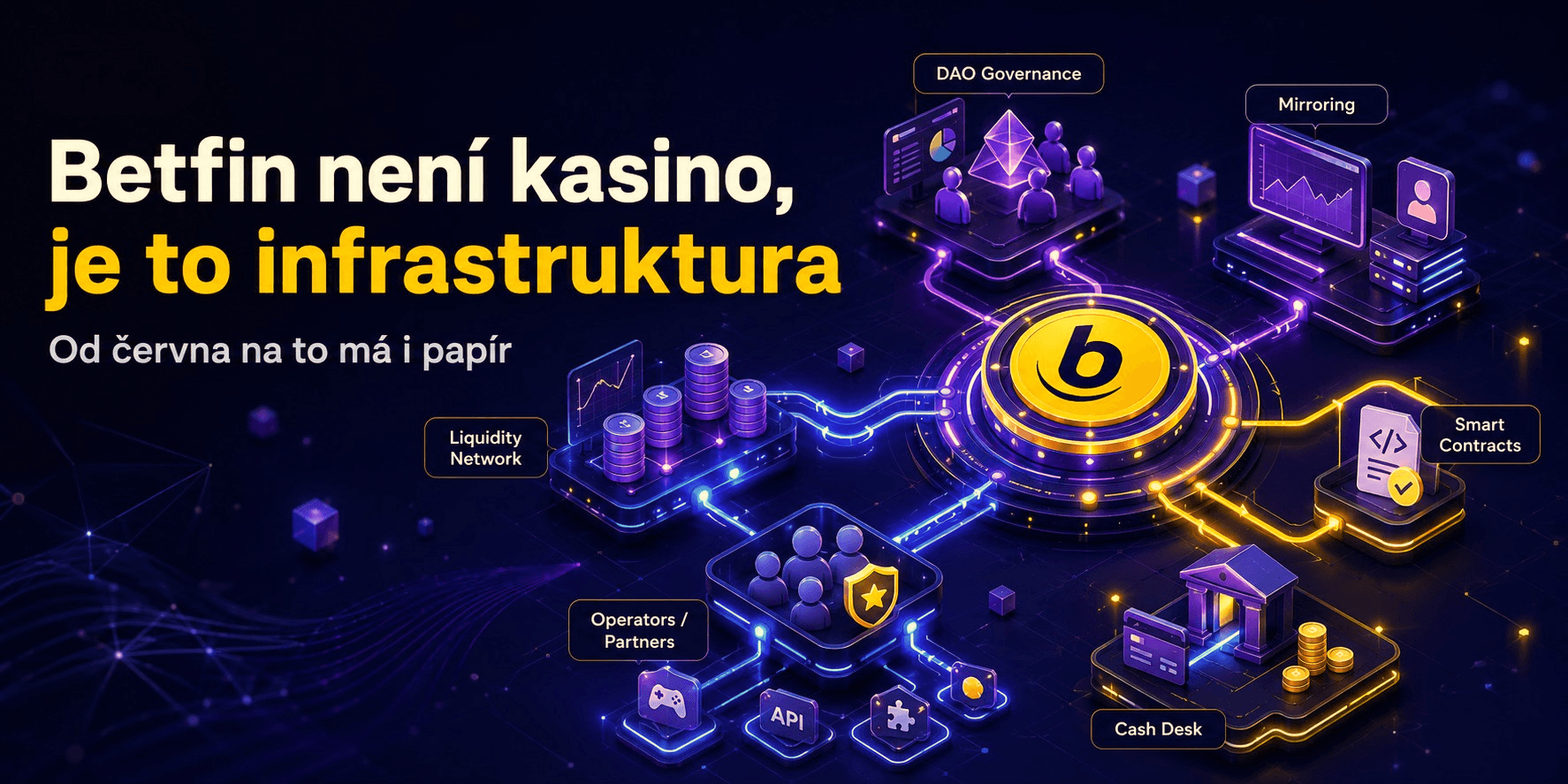
In Cycle 1, Betfin proved that a community can run a decentralised casino. In Cycle 2 we are going further. We are no longer building a casino. We are building the liquidity engine that any casino, sportsbook, or prediction market can plug into.
Today we can finally show you what that means in practice — because we have our first operator ready to go live.
1. The First Partner: wtf.games
The first third-party operator running on Betfin v2 technology is wtf.games.
A few things you should know about them:
- wtf.games is an independent third-party operator, operating under the internationally recognised Anjouan gaming licence. Betfin does not own, operate, or control wtf.games. Betfin provides the on-chain liquidity and infrastructure they connect to.
- They are launching with hundreds of games from day one, and the catalogue will grow to thousands.
- The sportsbook is already built and ready. They expect to launch it 1–2 months after the casino goes live.
- Prediction markets are planned for 3–6 months post-launch. These will be run on odds set by professional bookmakers, not peer-to-peer liquidity — which means they need a deeper liquidity base, and that is exactly what we are building.
This is the proof of concept for the v2 model: a licensed, regulated operator with a web2 frontend, running its entire gaming economy on Betfin’s decentralised liquidity.
2. What It Actually Means to Be a “Betfin Partner”
A partner is any operator — web2 or web3 — that connects to Betfin to use our liquidity instead of running their own bankroll.
Becoming a partner is permissionless. Anyone can deploy a partner contract and route volume into Betfin. There is no application process and no centralised control at the protocol level. What gets approved are individual games — each game and its economic terms must be approved by the DAO before it can go live.
Each partner deploys two things on-chain:
Partner Contract
The gateway that allows the operator’s users to interact with Betfin. Every user the operator sends to Betfin runs through this contract.
Mirroring Contract
A piece of on-chain code that captures every bet placed on the operator’s centralised platform and creates a corresponding bet on Betfin. The bets users place on their familiar website are mirrored in the background on Betfin, where the actual liquidity lives and the maths is settled.
These two contracts are the bridge between a regulated, centralised gaming frontend and the decentralised liquidity behind it.
3. How Operators Earn
In the v2 model, operators do not earn on player losses. They earn on volume.
The protocol takes the edge (the small mathematical advantage built into every game — typically 1% to 5%) and splits it. At launch, the parameters for wtf.games are:
30%
The partner (operator), for routing volume through their partner contract
20%
The deployer of the mirroring contract (in this case wtf.games again)
Remainder
The liquidity pool, the game developer, and protocol fees as per DAO-approved game settings
At launch, an operator running both a partner and a mirroring contract receives 50% of the edge on the volume they bring in.
Where does this share come from?
Both the partner share and the mirroring share are released from the reserve held in the Core contract — the protocol’s on-chain treasury. The operator does not take a cut directly from the player. They do not take a cut from the LP at the time of payout. They earn a share of the edge the protocol has captured, and it is released to them from the Core reserve as their volume is recorded on-chain. This keeps the relationship clean and transparent: every payment to a partner is visible on-chain and tied to verifiable volume.
Three important notes:
- These percentages are launch parameters. The DAO can adjust them at any time.
- The partner share applies equally to all future partners. The game developer share is set per game, and the DAO must approve each game and its terms before it can go live.
- All partner and mirroring payouts are paid from the Core contract reserve, not from individual player balances or from the LP at the time of a bet.
This structure is what makes the model work. An operator’s incentive is no longer to maximise their users’ losses — it is to maximise
how much their users play. Because the operator earns a small percentage of every bet, win or loss, their interest is in acquiring more users and letting them play freely. Players who win can withdraw freely. The long-run mathematical edge pays everyone.
4. Two Sides of the Same Coin: Who Earns, Who Takes the Risk
This part of the model deserves a slower read, because this is the most important idea in Betfin v2.
Edge is a long-run mathematical property, not a fact about any single bet.
Take European roulette. There are 37 numbers. If you bet on a single number and win, you receive 36x your stake. So you are risking 1 unit to win 36, but the probability of winning is 1 in 37. Over enough spins, the maths always lands in the same place: the house retains on average 1/37 of every unit wagered — roughly 2.7%. That is the edge. This does not mean the house wins every spin. It means that over enough spins, the average outcome is mathematically known.
The same logic applies to every game on Betfin. In the short run, players win and lose. In the long run, the outcome is volume × edge.
This is what Betfin v2 makes possible.
Because edge is a reliable long-run property, the protocol can do something traditional gambling cannot: separate the entity that earns from the entity that takes the risk.
The Partner (Operator)
- Brings volume. Markets the platform. Acquires users.
- A flat, fixed percentage of the edge on every unit of volume — paid from the Core reserve as volume is recorded on-chain.
- The costs and effort of running their business. They do not risk capital on player outcomes.
The LP (Community)
- Provides liquidity. Backs the bets.
- Their share of the protocol’s net result over time, plus affiliate rewards for referring users.
- The short-run variance of real gameplay. Some weeks the pool wins, some it loses. The maths favours the LP in the long run, but timing matters.
These are the two sides of the same coin.
The operator can receive a flat payout precisely because someone else is absorbing the variance. The LP earns the long-run mathematical edge precisely because they have accepted the short-run swings. One side could not exist without the other.
In traditional gambling, one entity — the casino — holds both roles. It absorbs the variance and captures the edge. In Betfin v2, these two roles are separated, on-chain, by contract. The operator does the work of bringing volume. The community does the work of providing capital. And the protocol does the work of distributing the maths correctly between them.
This is the service Betfin offers operators: the ability to run a gaming business without holding their own bankroll, by plugging into a community that is willing to be the bank in exchange for a share of the long-run outcome.
This is the service the community offers operators: capital that operators do not need to raise, in exchange for the right to a share of the volume those operators bring in.
It is a clean, mutual relationship. And it only works because edge is mathematically real.
5. The Flow of Funds — A Worked Example
Let’s walk through a simplified example so the mechanics are clear. The numbers below are illustrative and do not account for market frictions like slippage, gas, and timing.
Starting conditions:
- Game RTP: 97% (Edge = 3%)
- Volume routed through wtf.games in a given period: 1,000,000 units (denominated in whatever currency the partner accepts)
Step 1: The operator collects user funds.
wtf.games users deposit in whatever currency wtf.games supports. This happens entirely on wtf.games’ regulated, licensed frontend. Betfin is not involved at this layer.
Step 2: Bets are mirrored into Betfin in BET.
The operator’s service wallet mirrors every bet into the Betfin protocol using BET tokens. To do this, the operator must hold or acquire BET. Whether they buy BET on the open market via Gateway per-bet, or hold a float and rebalance periodically — in either case the operator must source BET from the market to operate. Over time, this creates a continuous demand for BET that tracks real protocol usage.
Step 3: The example maths, in proportions.
Total mirrored volume
1,000,000 units
Total winnings paid out (97% RTP)
970,000 units
Edge captured by protocol (3%)
30,000 units GGR
Operator share (50% of edge)
15,000 units, paid from Core reserve
Remaining edge
15,000 units, allocated to the liquidity pool, game developer, and protocol fees per DAO-approved game settings
The point is not the exact numbers. The point is the pattern: every unit of real GGR flowing through a Betfin partner generates continuous BET usage and adds net value to the liquidity pool, while the operator receives a flat, verifiable edge share from the Core reserve.
A note on the maths: where does the extra value come from?
An attentive reader will notice that 100% of the mirrored volume flows through the liquidity pool, and on top of that, 50% of the edge is released from the Core reserve to the operator. In BET-denominated terms, the system is distributing more value than the volume strictly generates in any given moment.
This is intentional and fundamentally different from generic token emission schedules.
The “extra” share comes from BET held in the Core contract reserve — a finite, capped pool set aside to incentivise partner acquisition during the protocol’s growth phase. It is not uncapped emission and it is not a yield-from-nowhere mechanism. It is a defined budget.
Most importantly, these releases are acquisition-gated: BET is released from the reserve only when an operator generates verifiable on-chain volume. No volume, no release. This is the opposite of calendar-based vesting schedules most projects use, where tokens are released regardless of whether anything productive is happening on the protocol.
Think of it as how BET enters circulation. Bitcoin is created through proof-of-work. BET is “mined” through proof of real protocol usage — every BET that leaves the reserve corresponds to a recorded, on-chain bet routed through a Betfin partner. The release schedule is the distribution mechanism.
The design intent is that by the time the reserve is fully distributed, BET will have deep liquidity, broad community ownership, and an established operational role across multiple gaming partners — strong enough to serve as the liquidity backbone of the industry without needing further incentive emissions. We cannot promise this outcome. It is what the architecture is built to achieve.
The DAO controls this budget. The community decides how aggressive or conservative the release policy should be as the protocol grows.
6. The Expansion of the Affiliate System
This is the part that took the longest to design, and we are proud of how clean it has come out.
Betfin’s affiliate tree exists on-chain. wtf.games is a centralised platform. Normally these two worlds cannot communicate without API integrations, shared user data, and privacy problems. We avoided all of that.
Here is how the mechanism works, step by step:
- Every wtf.games user is assigned a deposit wallet on-chain. This wallet is public and visible on the blockchain like any other address. The user does not control it — wtf.games does.
- The service wallet sends a Soulbound PASS NFT to that deposit wallet. The PASS is just a marker. It grants no rights, no revenue, no claim, and no membership in the Betfin DAO. DAO membership requires active liquidity provision, which a wtf.games deposit wallet does not do.
- If you are an existing Betfin member, you can register a wtf.games deposit wallet under your own Betfin wallet — one deposit wallet per partner. In practice this means inviting someone to wtf.games (via whatever channel you normally use) and then registering the on-chain deposit wallet linked to their wtf.games account under your Betfin wallet. From that point, that wtf.games account is connected to your position in the on-chain affiliate tree.
- When that wtf.games account plays, the service wallet places the mirrored bet on behalf of the deposit wallet. The Betfin protocol allows this — a service wallet can place a bet on behalf of another address, and the protocol records the bet as belonging to the deposit wallet.
- Because the deposit wallet now sits in your branch of the on-chain tree, the volume from that mirrored bet flows into the binary tree of the Betfin member who registered it. Your affiliate rewards accumulate from real wtf.games gameplay, on-chain, automatically, without anyone at wtf.games ever sending data to Betfin.
That is the whole trick. The service wallet does two simple things — mirror volume and place bets on behalf of deposit wallets — and the on-chain affiliate tree does the rest, the same way it does for any Betfin player.
To be explicit:
- A wtf.games user is not enrolled in anything they did not sign up for. They earn nothing from Betfin. The PASS on their deposit wallet is a technical flag, nothing more.
- No private user data is shared between wtf.games and Betfin. Everything happens on public on-chain addresses.
- The Betfin member who registers a wtf.games deposit wallet earns from volume that already exists on a public protocol — not from private information about who the wtf.games user is.
7. The Risk Disclosure You Should Always Keep in Mind
Providing liquidity is not risk-free. The liquidity pool absorbs the variance of real gameplay — and as explained in section 4, that is precisely why operators can receive a flat edge share. Both sides of the model exist because of the other. Most of the time the edge creates a steady inflow to the pool. Some weeks the pool will lose. In the long run the maths favours the LP — but timing matters.
The protocol has hard-coded safeguards: no single payout can exceed 5% of the total pool, and the DAO can set a maximum win per game. These are guardrails, not guarantees. Please keep them in mind.
8. What This Means for Betfin
This is the moment v2 stops being a roadmap and becomes a product.
- Operators get a bankroll without needing to raise one.
- Operators are paid from edge, not from player losses — which structurally aligns their incentives with player activity and retention rather than player losses.
- The community gets real volume from real, licensed partners flowing into the pool they are backing.
- BET gets utility tied to real protocol usage, not a narrative.
wtf.games is the first. The infrastructure is built so the second, fifth, and fiftieth partner can plug in the same way — and each one deepens the liquidity, the affiliate tree, and the demand for the token underneath.
We are no longer a casino. We are the liquidity layer that casinos run on. That has been the plan since the start of Cycle 2, and as of today it is live.
Thank you for building this with us.
— The Betfin Team
Betfin operates exclusively at the infrastructure and governance layer. It does not operate gaming services, custody player funds, or route user transactions. Third-party operators are independently responsible for their own licensing, AML, and compliance obligations. The BET token is a utility token — not equity, not debt, and not a security. Providing liquidity carries financial risk, including the possibility of loss.