
Around every project that combines blockchain and gaming, the same three questions come up sooner or later: who is actually responsible for what, who holds the keys, and what can an outsider verify on their own without having to take anyone's word for it.
At Betfin we answered them in the least glamorous but most durable way available: with a legal structure entered in a corporate register and with smart contracts anyone can open in a block explorer. The past five weeks have shown that the foundation is no longer theory on paper but live operations with real volume. This article explains how it all fits together.
The legal framework: BF Protocol DAO LLC
On 1 June 2026, BF PROTOCOL DAO LLC was filed with the Office of the Registrar of Corporations in Majuro, Marshall Islands. It is an algorithmically managed for-profit DAO LLC formed under the Limited Liability Company Act of 1996, the Business Corporations Act and the Decentralized Autonomous Organization Act of 2022. The Operating Agreement is effective as of 1 April 2026.
The Marshall Islands are one of the few jurisdictions that recognise a DAO as a fully fledged legal person rather than as a legal curiosity that has to be forced into a box built for something else. That matters, because the structure described below is not a construct assembled around regulation. It is the form the legislator created for precisely this type of organisation.
The company's purpose is defined narrowly in the Operating Agreement, with no room for interpretation: developing, maintaining and governing source-available protocol infrastructure licensed under the Business Source License 1.1, which enables independent third parties to build and operate gaming applications, together with managing the associated token ecosystem and liquidity framework. And immediately after it comes the sentence that is central to understanding the entire project: the company does not operate any consumer-facing gaming or gambling service, does not direct individual user transactions and does not collect gaming or gambling revenues.
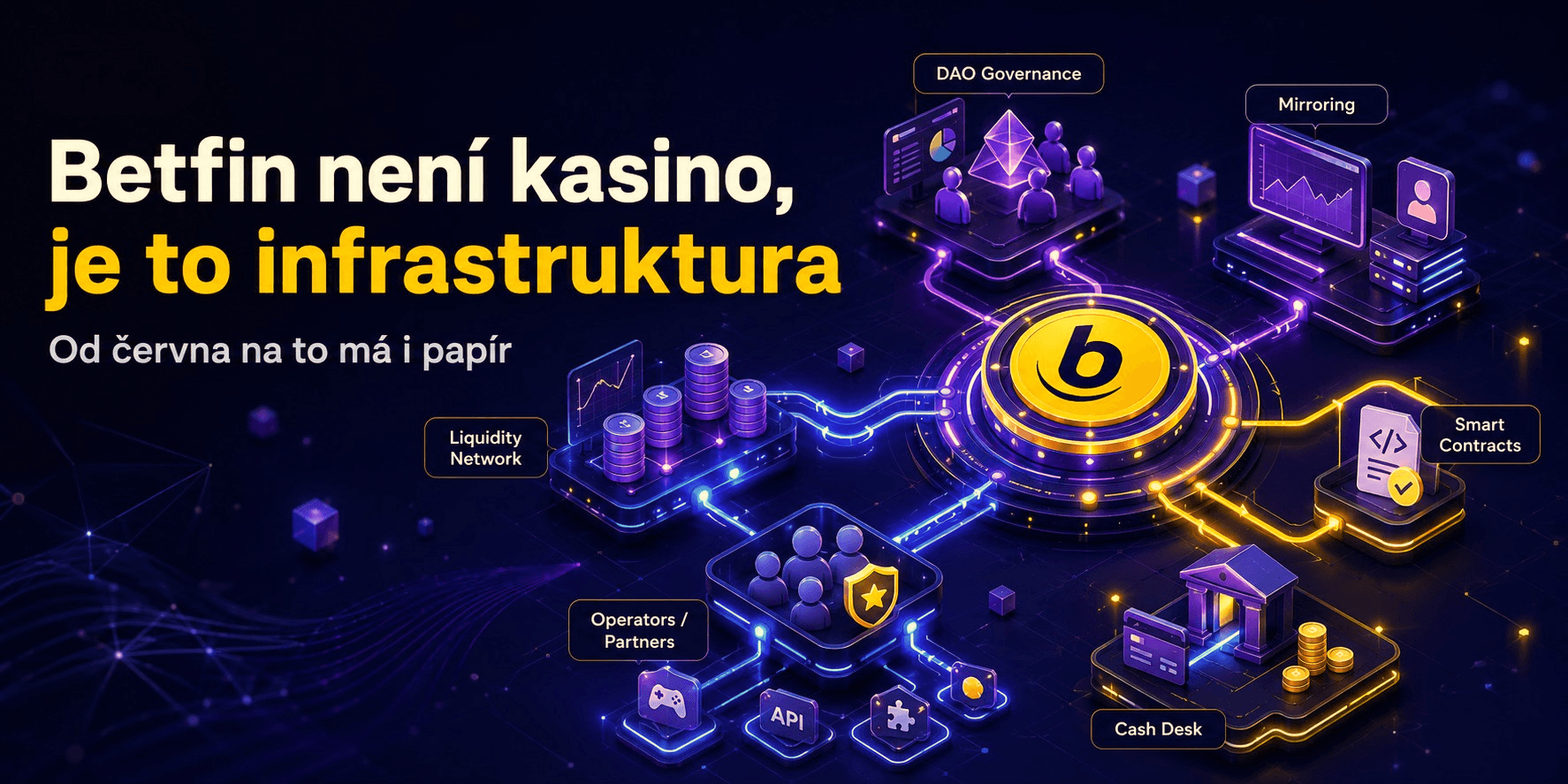
Betfin is therefore not a casino that bolted a token onto itself. It is the layer casinos run on.
Who is responsible for what
From this follows the division of responsibility that the document calls relationship architecture. The company operates exclusively at the infrastructure and governance layer and has no direct contractual, custodial or service relationship with end players. Its counterparties are limited to three types of entity: independent game operators who deploy their applications on top of the protocol, game developers whose contracts and strategies are registered through a governance vote, and gateway operators registered by the same route.
Each of these operators carries its own licensing, its own AML programme, its own KYC and its own front-end obligations in every jurisdiction where it is active. This is not a formulation written for lawyers. It is a real allocation of risk. Gambling regulation is by its nature regulation of the operator, meaning whoever accepts the bet, holds the player's funds and pays out the win. Betfin does none of those things.
What it can and does do is set technical and compliance standards as a condition of integration, and deregister anyone who stops meeting them. The governance layer therefore has leverage over partners but no operational control over them. That is exactly as it should be.
Who holds the keys
This is where the Operating Agreement is at its strictest, and it is worth knowing why.
Administrative roles over all protocol contracts, including DEFAULT_ADMIN_ROLE and UPGRADER_ROLE, are held by the DAO contract, not by a person. The document states it explicitly: no individual, including the Managing Member, holds unilateral administrative authority over the protocol contracts. Where operational authority is genuinely needed, whether for routine maintenance, incident response or communication with authorities, the DAO contract delegates it to a specific address through an approved vote, and can revoke it at any time through the same mechanism.
The Managing Member is therefore an agent of the DAO contract for off-chain matters, not a boss. Their powers are defined in an on-chain message signed at the time of appointment, they can be removed by a vote, their number cannot exceed one without a vote, and they have completed KYC verification under Marshall Islands law. Roles held temporarily during deployment were to be transferred to the DAO contract within ninety days of the effective date or upon the first successfully executed governance vote, whichever came first. Every such transfer is an on-chain transaction that can be looked up.
Membership is created by minting a non-transferable PASS NFT, a soulbound token that cannot be sold or moved. Voting weight, however, belongs only to those who are also an active liquidity provider: the weight equals the amount of BET held in an active liquidity position. Any active LP can submit a proposal, voting runs for twenty-one days, approval requires fifty percent of total voting weight, and there is a twenty-four hour timelock between approval and execution.
And one figure deserves a sentence of its own: the voting weight of any single address may not exceed five percent of the total. No matter what anyone buys, they cannot decide the protocol on their own.
The only authoritative venue for governance is the DAO contract on Polygon. The website, the frontend and any discussion forum carry no decision-making authority whatsoever, they are purely an informational layer. Where they diverge from what is recorded on-chain, the chain prevails.
The three partners connected today
Now from structure to operations. Three partners are currently connected to the infrastructure.
Dexgames.io represents the dex-native branch, a gaming layer built directly on top of the protocol contracts, where the entire flow from bet to settlement remains a matter of on-chain logic. It is the cleanest illustration of what the infrastructure was built for: an independent team builds on top of the protocol, the protocol supplies liquidity and settlement, and nobody in between has to trust anybody.
Wtf.games and hellcasino.com are licensed operators. They run the complete customer-facing side of the business, hold the relevant licences, carry out KYC and AML checks and bear full regulatory responsibility for gaming operations on their side. Betfin supplies them with liquidity and settlement infrastructure, nothing more and nothing less. This is precisely why the structure described in the sections above is not academic. Two connected entities today genuinely carry the regulatory burden where it belongs, and the protocol beneath them remains infrastructure.
That is a fundamental difference from most projects in this segment, which claim to be "just a protocol" while in fact running their own casino with their own cash box, having simply thrown a decentralised coat over it.
Mirroring: you do not have to trust, you can verify
The claim "we have partners connected with real volume" is unfortunately one of the cheapest claims in all of crypto. That is why Mirroring is part of the architecture: a layer that mirrors the gaming activity of connected partners into verifiable form.
In practice this means anyone can independently check three things. That the partners are genuinely active. That real gaming activity is being mirrored. And that the volume a partner committed to is actually being delivered. This is not a dashboard assembled by marketing. It is data produced by operations.
This point matters more to the project than it appears at first glance. It converts the question "can this team be trusted?" into the question "do the numbers add up?". And that is a question everyone can answer for themselves, without us.
Cash Desk, and why CoinGecko shows only a slice
Related to verifiability is a topic that keeps causing confusion in the community, namely the displayed BET volume.
Cash Desk is built on Uniswap V4 infrastructure. Its architecture differs fundamentally from earlier versions: instead of a separate contract for each pair, it uses a single singleton contract (PoolManager) through which all pools flow, complemented by hooks and flash accounting. For the protocol this is a significantly more efficient and cheaper solution. For third-party aggregators it is a problem, because indexers accustomed to watching swap events on individual pair contracts simply do not see part of the activity.
The result is that CoinGecko does not display the complete volume, creating a false impression that the token has neither liquidity nor activity. This is not manipulation by the aggregator or by us. It is a gap in the indexing of a new architecture.
Anyone who wants to see the real picture has it available on-chain. Actual volume, liquidity movements and activity are fully readable straight from the blockchain and from the Uniswap interface over the relevant pool. The DEX liquidity position is, under the Operating Agreement, property of the company held through the DAO contract, and its composition is independently ascertainable from on-chain records.
In other words: the data exists and it is public. You just cannot look at it through a window that cannot display it yet.
What this means for liquidity positions
The whole chain (licensed operators at the top, Mirroring in the middle, Cash Desk at the bottom) does not end at transparency. It ends at the yield of liquidity providers, because the real gaming activity of partners is exactly what feeds liquidity positions.
This is the moment where the structure described in the first half of this article translates into numbers. Not because anybody promised anything, but because operators were added, volume was added, and the mechanism that responds to volume worked exactly as it is programmed to.
Why Betfin is not and cannot become a Ponzi scheme
Sooner or later everyone asks this question about projects with a yield from liquidity, and it is right to ask it. The answer is simpler than expected, because a Ponzi scheme needs two specific things in order to function. First, custody, meaning a pile of other people's funds that the operator has access to and can freely dispose of. Second, a non-existent source of yield, which is why the profits of the first participants have to be paid out of the deposits of the last ones.
Betfin has neither.
Betfin does not hold a single BET token of its liquidity providers in custody. The tokens locked in the liquidity pool are held by a smart contract, not by the company, not by the team and not by any wallet under our control. The claim to those funds is held by each provider personally, in their own wallet, in the form of an NFT representing their liquidity position.
In practice this means a deposit never travels to a company account and never passes through hands that could redirect it elsewhere. The contract does exactly one thing with it, the thing it was written for: it uses it as bankroll for the games of connected operators. So it is working capital, not stored capital, and title to it stays for the entire time where it originated, with the provider. Betfin has no way to do anything else with those tokens, because it does not hold the keys to them. Neither does the Managing Member, because administrative roles over the contracts are held by the DAO contract, as the section on keys above describes.
The second leg of the construction is the source of yield, and it is just as boringly concrete. Yield does not arise from the deposits of new providers but from the real activity of the gaming partners connected to the infrastructure. In this arrangement the liquidity provider is the counterparty to the player, and what accrues to or is deducted from the position is the mathematical outcome of the games played. This is exactly why Mirroring is part of the architecture and not of the marketing: it lets anyone verify that the volume the yield comes from genuinely exists, and where it came from.
And then there is a detail you will never see in a Ponzi scheme, by definition. The liquidity pool can be at a loss. The Operating Agreement says so openly and the smart contract allows for it, because variance is a natural part of standing on the house side. A system that promises smooth yield with no bad cycle is suspicious for that very reason. A system where the pool moves in both directions depending on how the games played out is doing exactly what it should.
For this to become a Ponzi scheme, Betfin would first have to stop being what it is. It would have to take custody, which would mean replacing the contracts, and that is possible only through a governance vote recorded on-chain, with a twenty-one day voting period and a twenty-four hour timelock. Nobody would find out about it afterwards. Everyone would see it in advance, on the chain, with time to react.
What Betfin does not guarantee
Part of putting people at ease is also stating what texts like this usually leave out, and what the Operating Agreement instead puts in black and white.
BET is a utility token. It does not represent equity in the company, it is not a debt obligation and it does not confer any right to share in profits or revenues.
It equally holds that the protocol runs autonomously and that its outputs, including gains and losses of the liquidity pools, are determined by the mathematical logic of the contracts, not by decisions of the team. Providing liquidity is a bilateral arrangement between the provider and the operators using the protocol, not a collective investment managed by the company. Deposits are subject to the lock period defined in the liquidity pool contract, and it is each member's responsibility to read the parameters before depositing.
These are not disclaimers glued to the end out of obligation. They follow the same logic as everything else in this article: what you can verify, we assert; what cannot be verified, we do not promise.
Where to verify it
All the relevant addresses are in Exhibit A of the Operating Agreement and on Polygon. Governance runs on the DAO contract 0x4A682F168D8454DCAACc4461544D57a263394F88, membership is verified through the Pass contract 0x4D81A401Edef4119778e96Eb443d92F34DE37c99, active liquidity positions and the voting weight derived from them through the LiquidityPool contract 0xBFB31f7F7F8e062d10e1B1C11a5d4fE9c4BC158A, and the token itself through the contract 0xbF7970D56a150cD0b60BD08388A4A75a27777777.
Conclusion
When it all comes together, it looks like this. Betfin is structured legally and from a regulatory standpoint as infrastructure, licensed operators carry the gaming obligations on their side, and the entire flow from operators through Mirroring into the Cash Desk is transparent and independently verifiable.
This is not a structure designed to hide something. It is a structure designed to move as much as possible out of the realm of "trust us" and into the realm of "see for yourself". And as the last cycle shows, the moment real licensed operators with real volume connect to this infrastructure, it shows up in the place members care about most.